
From Your Weekly Stronger · October 5, 2026
TIP OF THE WEEK
How Many Steps Are You Taking?
Look at your total steps for the day—not just your exercise walk. Steps around the house, at the store, and out with friends all add up. For many older adults, about 7,000 steps a day is a practical goal to work toward, adjusted to your health and ability.

Find Your Starting Point
- Use your watch, phone, or pedometer to track a typical week. Keep your phone with you so it records your steps.
- Find your daily average. If you are below your goal, try adding around 500 steps a day as a manageable first increase.
- Build gradually as it feels comfortable. Short walks throughout the day can help; you do not need to reach your goal all at once.
What the Studies Say
A 2022 review of 15 studies found that, in adults 60 and older, more daily steps were linked with lower risk of death, with the association leveling off around 6,000–8,000 steps a day. A 2025 review also supported roughly 7,000 steps as a meaningful target across several health outcomes.
These studies show associations, not guarantees. You can benefit below that range, and 10,000 is not a requirement. Start where you are, keep your strength and balance training, and set a comfortable goal with your trainer.
Research: Paluch et al., 2022 • Ding et al., 2025
EXERCISE OF THE WEEK
The Suitcase Carry
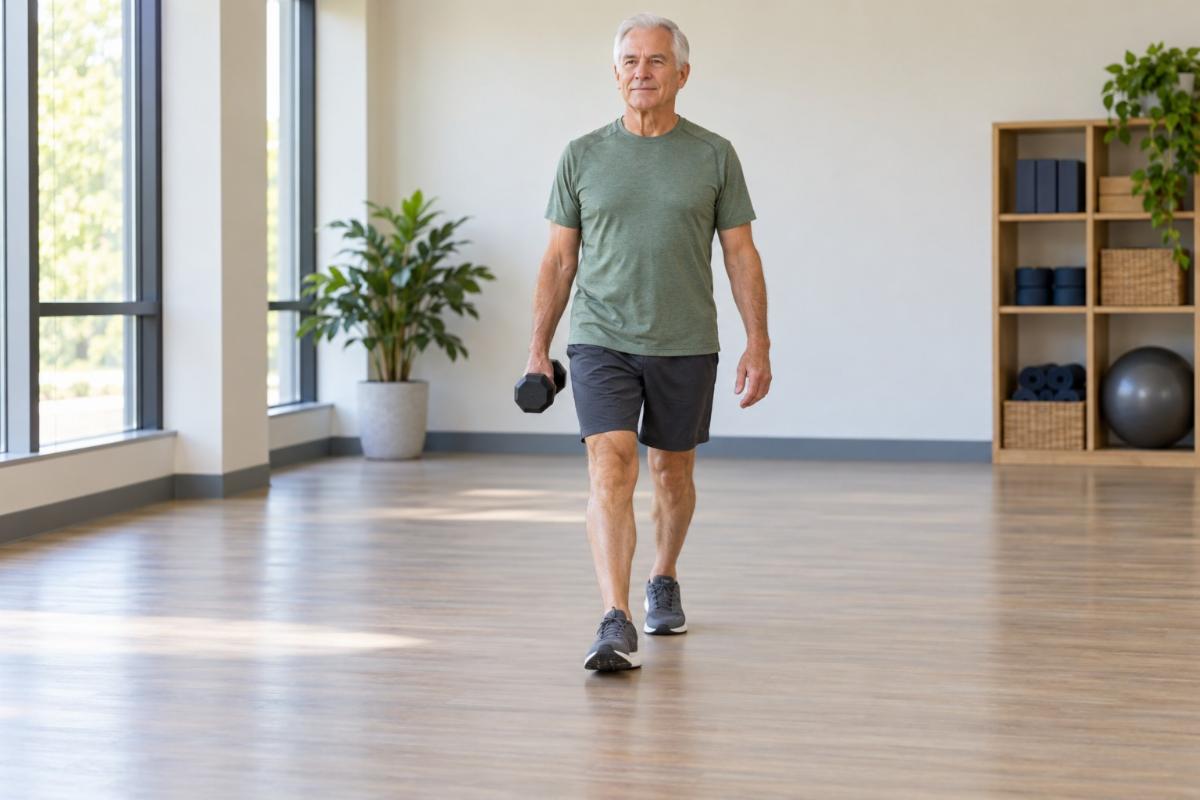
One weight, one hand, a steady walk. Your grip holds the load and your core resists the pull to one side. Posture comes first: stay tall, brace your core, and do not lean.
How to Do It
- Hold a light dumbbell at one side. Stand tall with your head over your shoulders, ribs over your hips, and shoulders level.
- Brace your core by gently tightening your midsection, as if preparing for a light nudge. Keep breathing normally.
- Maintain that posture with every step. Do not lean toward or away from the weight. Keep your eyes ahead and walk slowly.
- If you start to lean, stop and use less weight or a shorter walk. Set the weight down safely, then repeat on the other side.
Posture Comes First
Start light: Choose a load that lets you maintain excellent posture.
Stay tall: Keep your shoulders level; do not tilt or lean to either side.
Brace your core: Keep your midsection engaged throughout the walk.
Keep breathing: Breathe normally while you maintain the brace.
Work both sides: Give each hand an equal turn.
Make It Easier
Use less weight or a shorter walk. Ask your trainer about a standing hold if walking with a load feels unsteady.
Make It Harder
Add a little time or weight only when you can maintain excellent posture and core control for the entire walk. Never trade posture for a heavier weight.
THIS WEEK'S CHALLENGE
Know Your Daily Step Average
Track your total steps this week and bring your average to your next session. We can set a realistic goal—and practice suitcase carries with posture and core control as the priority.
Safety First
Use a clear, level surface and a manageable weight. If you use a walking aid or feel unsteady, practice with your trainer first. Stop for pain, dizziness, or loss of control.
Sources and further reading
Put it into practice with your trainer
Bring your questions to your next session, explore personal training at Saddlebrooke Strength, or schedule a free introductory call.